
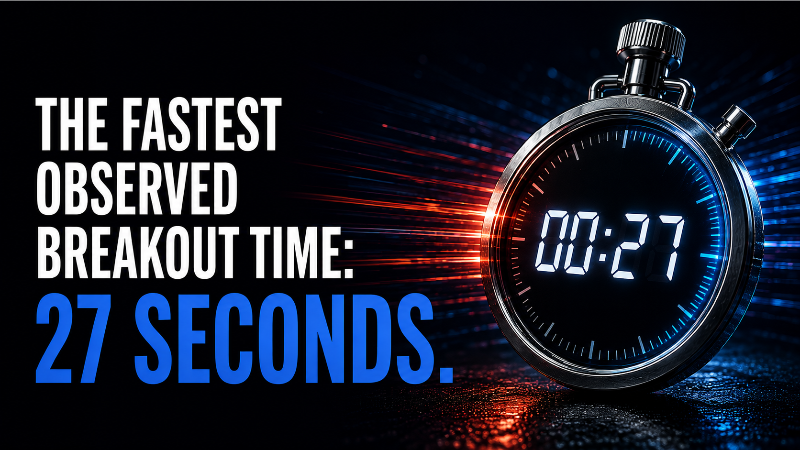
CrowdStrike’s 2026 Global Threat Report includes a sobering number:
27 seconds.
That was the fastest observed breakout time for an intrusion in 2025.
Not 27 minutes. Not 27 hours. 27 seconds.
Breakout time is the window between initial access and lateral movement, when an adversary moves from foothold to expansion.
For years, cybersecurity has treated incident response as something that begins after a confirmed incident. An alert fires. A ticket is opened. Someone reviews it. Someone escalates it. A bridge is created. Decisions are discussed. Containment may require approvals. Leadership is briefed.
That model made sense when the defender had time. The defender does not have time anymore.
If an adversary can break out in 27 seconds, incident response cannot remain an episodic process assembled after confirmation. It has to become a continuous operating capability built into how the enterprise governs, detects, decides, contains, learns, and improves.
That is the case for Continuous Incident Response.
CIR recognizes that incident response is no longer a discrete event at the end of detection. It is an enterprise discipline connecting security operations, infrastructure, identity, cloud, applications, data, legal, communications, leadership, and business ownership into one response model.
A mature CIR capability requires visibility across endpoints, identities, cloud workloads, networks, applications, and data. It requires correlation across those domains so defenders can see the shape of an intrusion instead of chasing disconnected alerts.
Most importantly, it requires pre-authorized response actions.
Speed is not created during an incident. It is created before the incident by deciding what actions are authorized, who can take them, under what conditions, with what evidence threshold, and with what notification requirements. Pre-authorized actions are automated: the action is taken, then a human is notified.
If containment requires a meeting, the adversary wins.
If disabling a compromised account requires a debate, the adversary wins.
The middle of an intrusion is a terrible time to negotiate authority.
CIR also changes tabletop exercises. A tabletop should not be a compliance ritual. It should test decision velocity: how fast can we validate, contain, communicate, restore trust, and identify the dependency, owner, approval path, or uncertainty that slows us down every time?
That is where the real work is.
In public sector environments, cybersecurity is not merely about protecting systems or data. It is about protecting essential services and preserving public trust.
Twenty-seven seconds is not a statistic. It is a warning.
The question for security leaders is no longer whether we have an incident response plan. Most organizations do.
The question is: Can our incident response capability move at the speed of the adversary? If the answer is no, then the plan is insufficient.
It is time to build Continuous Incident Response.

Leave a Reply