
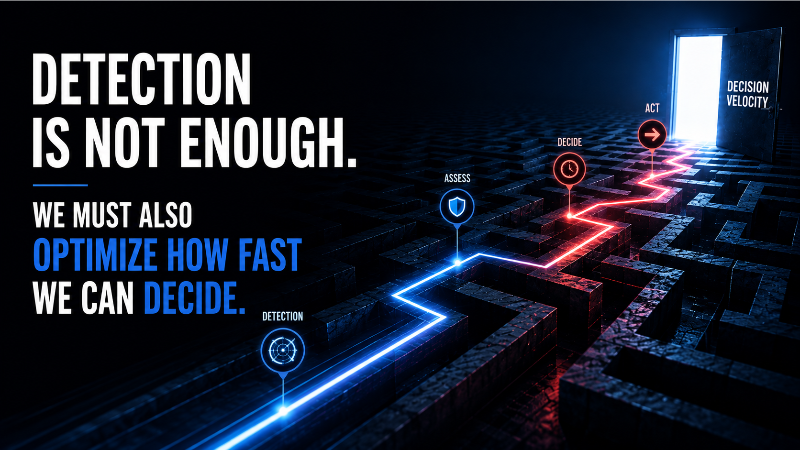
As adversaries move laterally in seconds, detection alone isn’t enough.
We must also optimize how fast we can decide.
Recently, I wrote that IR must evolve from an episodic process to a continuous operating capability—because modern threats outpace traditional structures.
Speed isn’t generated only in the SOC. It’s forged in governance.
We’ve invested years in reducing mean time to detect (MTTD), respond (MTTR), and contain. These are vital metrics. But they don’t measure whether the organization can authorize action when it matters most.
Detection is not authority to act.
An analyst may see the threat. The team may have the tools. Automation may be ready. The playbook may be clear.
Yet if ownership is ambiguous, approval chains unclear, business impact tolerances undefined, or notification requirements undecided, response grinds to a halt.
This is decision latency—the dangerous gap between knowing what should happen and being empowered to do it.
It surfaces in uncertainties around:
• System and data ownership
• Identity and cloud authority
• Vendor responsibilities
• Acceptable operational disruption
• Legal and executive notification paths
Each uncertainty costs precious time. And in an incident, time is advantage for the adversary.
CIR maturity isn’t measured by having a plan. Most organizations have one.
It’s measured by whether the decisions the plan depends on have already been made—before the intrusion begins.
Who can act? Under what evidence threshold? With what accountability? With what tolerance for disruption?
These questions belong in governance, not crisis calls.
True Continuous Incident Response requires alignment across security, infrastructure, identity, cloud, applications, data, legal, communications, vendors, executives, and business owners. That alignment comes from trust, clarity, and pre-established decision rights.
In cybersecurity today, speed is a governance outcome.
The next frontier for incident response maturity may not be faster detection or containment.
It may be how quickly we can decide.
What decision rights or pre-authorizations has your organization established to reduce decision latency?

Leave a Reply